 A community
“Stable” and “master” are useful selection names. A trial record also needs the commit that was actually checked.
Keep the name and resolved object
Git’s revision syntax can name commits through branch names, tags and object IDs. For a local checkout, git rev-parse HEAD reports the current object ID. This is an observation of that checkout; it does not certify its origin, cleanliness or suitability for an application.
Record the repository location alongside the resolved revision. A familiar tag in an unrelated repository is not the same evidence as an identified checkout from the intended project. Avoid inventing a commit hash for an example that readers might mistake for a recommended release.
# Run inside the SDK checkout you are investigating
git rev-parse HEAD
git status --short

# Run the selected Flutter executable separately
flutter --version
Account for local modifications
A commit identifies recorded history. Local modifications can change the source used in a trial without changing HEAD. Read status and review the relevant diff. Do not reset or discard changes simply to make the record look clean; first establish who owns them and preserve the work.
| Record | Example entry | Meaning |
|---|---|---|
| Requested name | master | The selection may move |
| Resolved revision | Paste the real full object ID | The checkout observed at that time |
| Local changes | Present: attach reviewed diff | HEAD alone does not describe all inputs |
| Target evidence | Named test/build logs | The checks belong to this selection |
When a branch advances
Suppose a synthetic test passes on Monday and fails on Thursday using the same branch name. Compare the resolved revisions before treating the runs as equivalent. If the revision changed, keep both identities and rerun the same test under controlled inputs.
A repeatable record keeps the application revision, dependency lockfile, target and build mode too. If several inputs changed together, the evidence establishes a changed environment; it does not yet identify the responsible change. Continue by isolating one variable at a time.
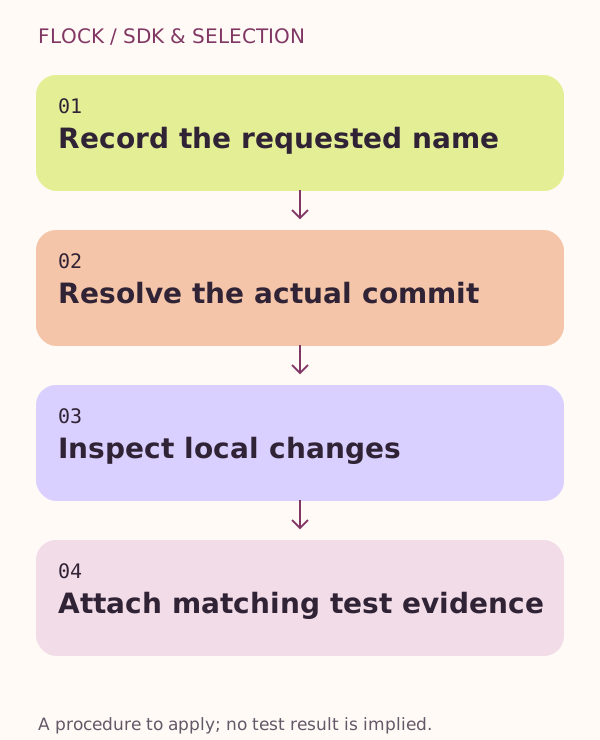
Record the requested name → Resolve the actual commit → Inspect local changes → Attach matching test evidence.