 A community
A release record should make it possible to tell exactly what was built, what was checked, and which results belong to that build.
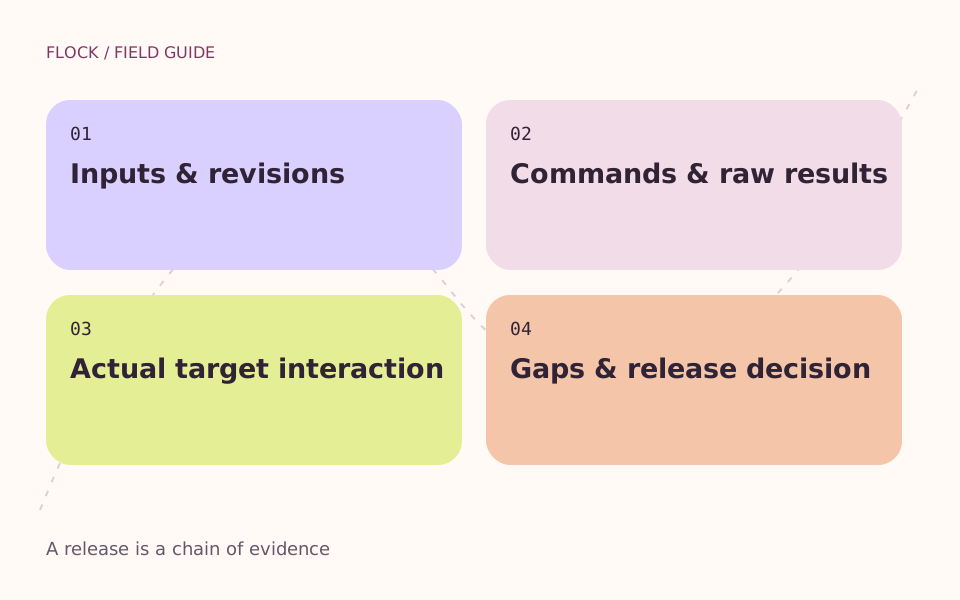
Inputs & revisions → Commands & raw results → Actual target interaction → Gaps & release decision.
The minimum useful bundle
Identify the inputs
Record the app revision, SDK repository and revision, package lockfile, target, mode and relevant tooling. Keep secrets out of the shared record.
Keep checks separate
Capture the command, exit status and result for analysis, tests and each target build. Keep a failed run rather than replacing it with a later summary. Label reruns with their changed inputs.
Record an actual user flow
Describe the device or browser and steps used. Record expected and actual behaviour. “Build completed” is not evidence that a dialog, menu or platform permission flow worked.
List gaps and the decision
State unavailable targets and skipped checks explicitly. Give the decision, the remaining issue and the rollback selection. Do not turn “not tested” into “no problems found”.
Release record — synthetic template
App revision:
SDK repository / revision:
Framework / engine / Dart versions:
Target / build mode / operating system:
Lockfile identity:
Command | exit | artifact or log | result:
Critical flow | expected | observed:
Not tested:
Decision / reviewer / date:
Rollback selection:
One failure, one honest conclusion
Suppose analysis and widget tests pass, but an iOS build was not run because no build environment was available. The record may support accepting a web-only trial. It does not support claiming an iOS-ready release. Keep the stated scope narrower than the evidence.
Use the evaluation worksheet when comparing SDKs. Use the reporting guide if a check exposes a failure. This checklist is an editorial procedure, not a certification of your application.
Sources & further reading
Go deeper on this task
- Plan a fair Flutter fork performance comparison
Control the device, build mode, workload and measurement conditions before comparing two SDK candidates.
- Read CI results without trusting the cache label
Compare a CI job’s actual SDK, dependencies, target and result with the local investigation.