 A community
Review the promised behaviour first, then inspect whether the patch and its checks actually support that promise.
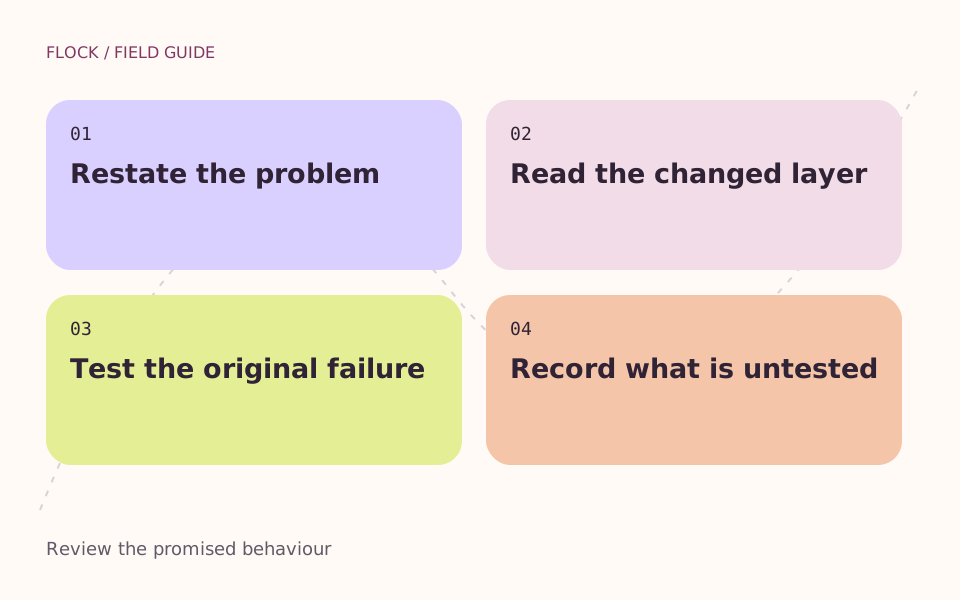
Restate the problem → Read the changed layer → Test the original failure → Record what is untested.
Restate the problem
Write one sentence describing the failure or task. Identify the upstream issue and smallest reproduction. If the change’s goal is unclear, ask for that context before treating a passing test as sufficient.
Identify the touched layer
Read the diff and name the framework, engine or tooling changes. Compare the patch with the upstream revision it applies to. Keep unrelated formatting and dependency changes out of the behavioural comparison.
Look for a check that could fail
Ask whether the regression check demonstrates the original failure and passes with the patch. A test that merely repeats implementation details may miss the behaviour the user cares about.
Check the real boundary
Repeat the relevant target flow. Include keyboard, empty inputs or platform behaviour when those are part of the problem. Mark unavailable devices and modes as not tested.
Record the maintenance decision
Describe remaining risks, upstream divergence and the condition for removing or revisiting the patch. Separate your review record from the repository’s actual merge decision.
Worked review note
Synthetic review: dialog focus patch
Purpose: Restore focus to a surviving control after a row is removed.
Scope: Framework-level focus handling.
Regression check: Original sequence fails before the change.
Target interaction: Repeat keyboard sequence in the target app.
Boundary: Close without removing a row; remove the last row.
Not tested: Other desktop platforms.
Decision: Request missing target evidence before adoption.
No repository was changed by this example. The historical contribution guide explains the patch-based workflow used by Flock. The layer map helps you avoid treating a source-level result as a complete runtime result.
Sources & further reading
Go deeper on this task
- Review a widget regression test by its behaviour
Check whether a Flutter widget test demonstrates the original failure and protects the behaviour a user needs.
- Review an upstream conflict before editing a patch
A review worksheet for distinguishing a text conflict from a changed behavioural requirement in a Flutter fork.