 A community
A conflict means two source changes need reconciliation. A clean application means the text could be applied. Neither outcome, by itself, establishes correct behaviour.
Restate the patch’s purpose
Start with the original issue, the intended user-visible behaviour and the regression check. Identify the old upstream revision, the proposed upstream revision and the local patch. Without these identities, a diff is difficult to interpret and a conflict-resolution review has no stable scope.
Use a separate investigation checkout. Read the relevant changes without discarding shared work or force-pushing a branch. Git status and diff can expose local changes; preserve them before attempting a mutation.
Conflict review worksheet
Patch identifier and original purpose:
Original regression case:
Old upstream revision:
Proposed upstream revision:
Conflicting source area:
What upstream changed in behaviour:
Does the patch still solve an unmet problem?
Proposed resolution and supporting tests:
Target interaction still required:
Decision: keep / revise / retire through review / investigate
Read both sides for meaning
- Explain the patch’s effect in one sentence.
- Read the upstream change affecting the same behaviour.
- Identify whether upstream already addresses the original problem.
- Review the proposed resolution against the original regression case.
- Repeat relevant target checks before accepting the result.
Do not choose one side merely because it removes conflict markers. A superficially tidy file can erase either the upstream fix or the fork’s intended behaviour.
A complete example decision
In a synthetic focus-handling conflict, upstream changes the lifecycle of the control that the patch previously targeted. The reviewer first checks whether the original failure still exists. If it does, the patch may need a different implementation; if it does not, retirement needs evidence and the project’s review process.
The result is a documented maintenance decision, not a claim that this website merged or removed a real Flock patch. Keep the actual diff and test results attached to the source revisions used for that decision.
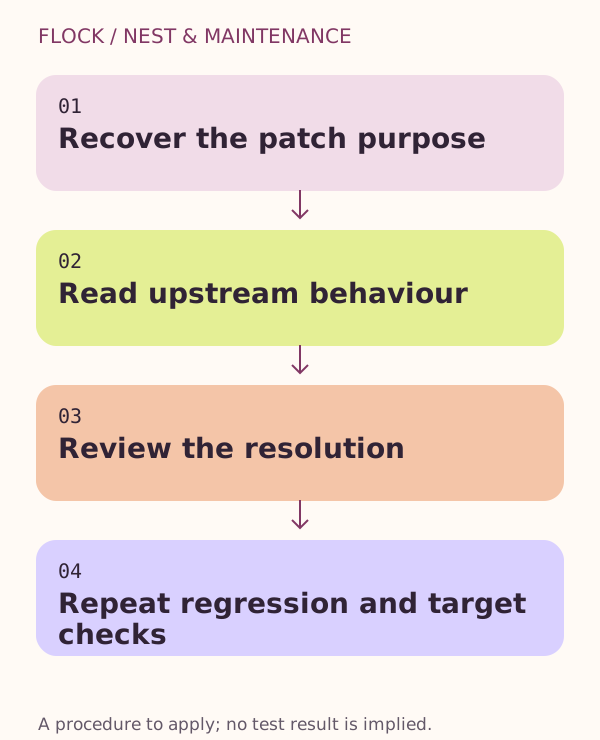
Recover the patch purpose → Read upstream behaviour → Review the resolution → Repeat regression and target checks.
Primary sources
Continue with the next step
Resolve the next specific question
- Read a Nest patch manifest before replaying it
Inspect order, files, source-defined arguments and checkout identity without changing Git history.