 A community
A rollback is complete when the intended baseline is selected again and the chosen baseline check has been repeated. Changing a configuration label is only part of that procedure.
Prepare the return route before the trial
Preserve the original app revision, SDK identity, project selection and dependency state before evaluating a candidate. Keep changes made during the trial separate from unrelated application work. Without that separation, “go back” can mean several different operations.
If the project uses FVM, retain its working configuration and identify how the IDE selects the project SDK. Do not assume that restoring a JSON file immediately changes an already-running process or editor session.
Restore deliberately
- Stop the trial operation and preserve its logs.
- Review application and configuration differences; identify their owners.
- Restore the previously recorded selection using the project’s normal workflow.
- Confirm the selected executable and SDK revision in the relevant context.
- Repeat the known baseline check and record its result.
| Item | Baseline record | After rollback |
|---|---|---|
| SDK | Repository and full revision | Observed identity matches / differs |
| Dependencies | Recorded resolution | Same / changed with explanation |
| IDE or CI selection | Recorded SDK route | Confirmed in the context that matters |
| Original check | Command and expected outcome | Actual rerun and log |
When the baseline still fails
Suppose a synthetic trial is rolled back, but the original build now fails. Do not declare the rollback successful solely because the SDK version looks familiar. Compare dependencies, local source changes, generated inputs and relevant toolchain changes. Preserve the failure while narrowing the mismatch.
A rollback does not require deleting every cached SDK, resetting application history or discarding someone else’s work. Those actions can destroy the evidence needed to understand what changed. Keep the operation limited to the trial’s documented inputs and use the project’s own review process for changes beyond that scope.
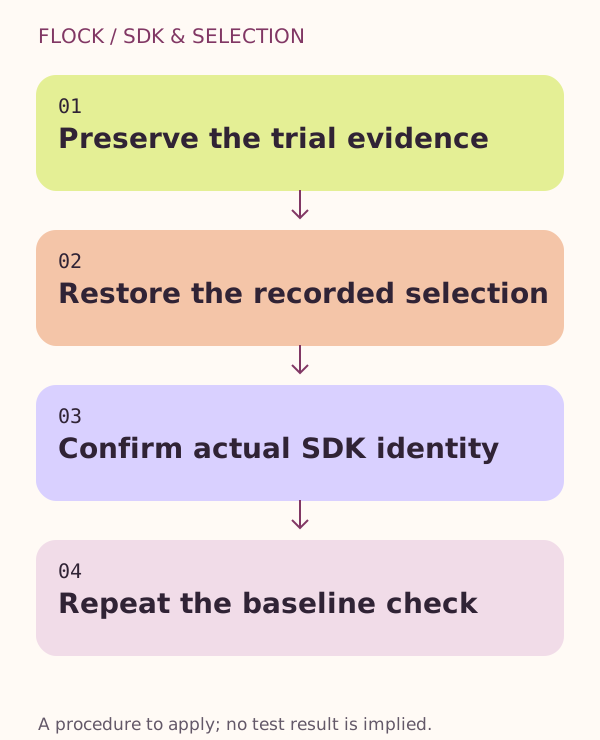
Preserve the trial evidence → Restore the recorded selection → Confirm actual SDK identity → Repeat the baseline check.